


If you’ve ever walked into a building where the stone floors feel perfectly even, the colors look rich and consistent, and the surface has that clean, almost “effortless” polish, there’s: advanced technology. Iran has always been known for its natural stone—travertine, marble, granite, and everything in between—but what’s happening in recent years is something different. The industry is shifting from mostly traditional methods to tech-driven, highly precise processes. And honestly, that shift is changing the story of Iranian building stone in a big way.
Before diving into the details, let’s set the scene. The global stone market has become incredibly competitive. Architects want cleaner finishes. Export markets demand consistent sizing. And buyers—whether they’re from Italy, China, or the UAE—expect durability that can survive decades of use. For Iranian producers to compete, relying only on manual extraction or outdated polishing lines simply doesn’t cut it anymore.
This is where modern machinery steps in and, well, rewrites the rules.
How Technology Has Transformed Stone Extraction
Let’s start from the very beginning: the quarries.
A few decades ago, extracting blocks was a seriously rough business. A lot of the process depended on manual judgment, experience, and—let’s be honest—a bit of luck. Blocks often came out cracked or irregularly shaped. Yield was low. Waste was high.
Now imagine the same quarry but equipped with:
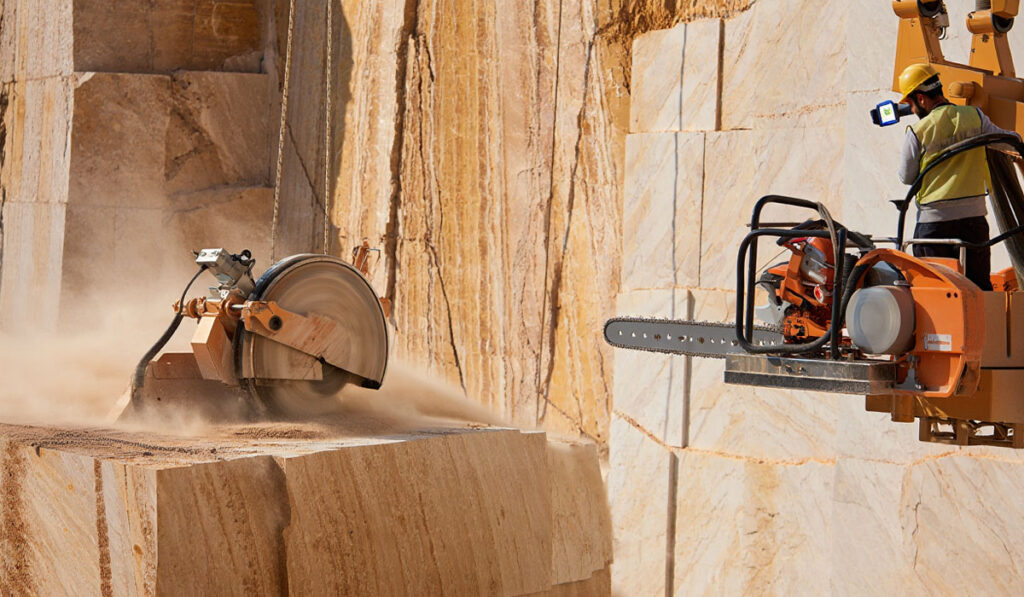
- Diamond wire saws that slice through stone with precision
- Chain saw machines that reduce micro-cracks
- Surface miners that create cleaner block faces
- 3D mapping systems that help operators “see” inside the quarry wall before cutting
With these tools, extraction isn’t guesswork anymore. It’s calculated, efficient, and way less damaging to the stone. When a quarry uses diamond wire cutting instead of blasting, for example, you immediately notice the difference: the stone comes out in larger, cleaner blocks with far fewer structural defects.
The result? Better quality from the very first step—because if the block itself is healthier, every step afterward becomes easier and more stable.
Modern Sorting and Scanning Systems: A Quiet Revolution
Ask anyone in the stone business: sorting is where fortunes are made or lost. A stone slab with subtle cracks or inconsistent coloring might be usable—just not for premium markets. In the past, sorting was 100% visual, and that meant one thing: human error.
Today, advanced factories in Iran are adopting:
- Automated optical scanners
- AI-based surface detection systems
- Color consistency analyzers
- Moisture and density sensors
Let me explain it simply. Imagine you have a stack of slabs, all beige travertine. To the naked eye, they look the same. But when passed under a scanner, the system quickly picks up small changes: a lighter vein here, a slight shadow there, a tiny filled cavity.
These machines grade stone in seconds, and they do it consistently. No mood swings, no fatigue, no “maybe this can pass.” The result is perfectly sorted batches—something international buyers care about a lot.
And by reducing misclassification, factories waste less stone and meet customer expectations more reliably. That consistency itself is a quality upgrade.
Cutting-Edge Polishing Lines: Where Real Magic Happens
Let’s be straight: polishing is where the stone’s personality shows up.
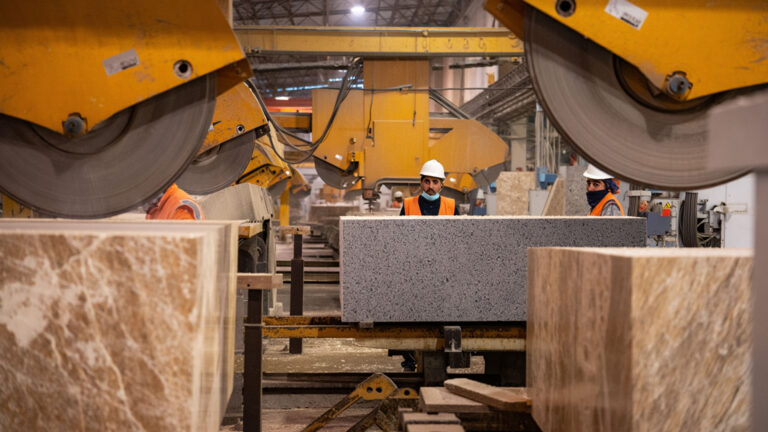
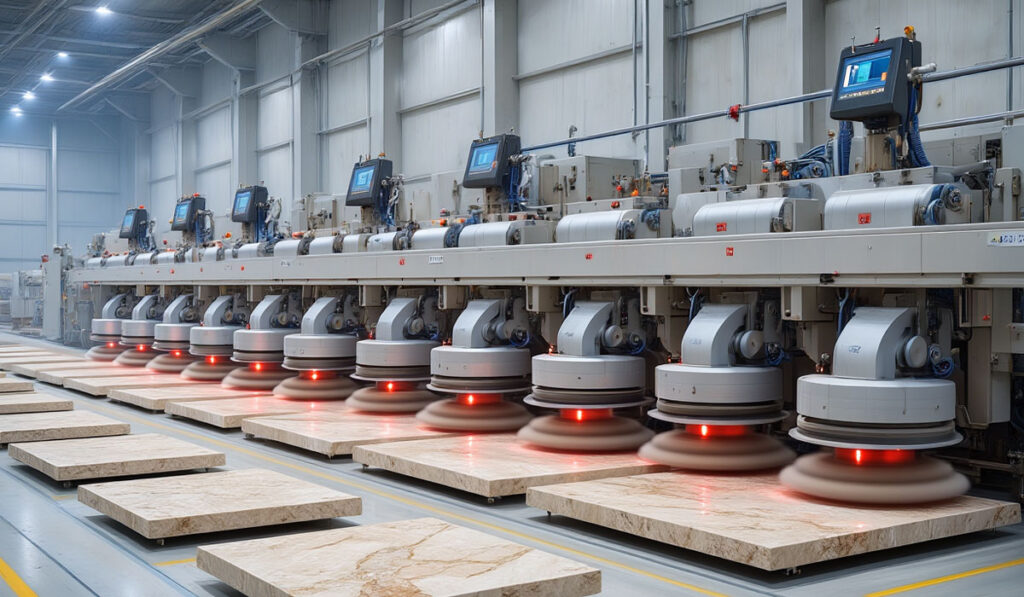
Traditional polishing used to involve manual pressure adjustment, uneven resin application, and surfaces that sometimes looked patchy. But modern polishing lines? They’re like watching choreography—measured, rhythmic, and unbelievably consistent.
Today’s leading factories use:
- Fully automated polishing lines with 16–20 heads
- Smart pressure sensors that adjust based on stone hardness
- Resin treatment machines that fill pores with exact dosage
- Laser thickness calibrators for perfectly uniform slabs
- High-speed honing and brushing units for textured finishes
If you’ve ever touched a stone surface that feels silky, reflective, and even from corner to corner—that’s the work of smart polishing.
A good example: Iranian travertine used to be known for holes and uneven surfaces. But with resin-injection machines and vacuum-seal technology, these stones now hit global markets looking almost Italian-grade. That’s not an exaggeration; buyers themselves say it.
And for rough-textured surfaces like leathered granite or antique marble, new brushing machines create finishes that used to be nearly impossible with manual tools.
CNC and Waterjet Technology: Precision That Expands Creativity
Not everything in the stone world is about slabs and tiles. Designers want curves, custom shapes, tiny details, and precision cuts that once seemed unrealistic.
Enter CNC milling machines and waterjet cutters.
Picture a complex hotel lobby floor with seamless geometry—circles, triangles, inlays, borders. A few decades ago, this would’ve required days of manual cutting with high risk of breaking the stone.
Now?
A waterjet machine cuts the exact design within minutes, with millimeter accuracy. No chipping. No wasted slabs.
CNC routers go even further. They carve:
- Columns
- Edge profiles
- Countertops
- Decorative reliefs
- Intricate façade pieces
These machines are the difference between “basic stonework” and “architectural storytelling.” And Iran’s adoption of them has made a visible difference in both local and export markets.
Robotics and Automation Are Quietly Entering the Scene
If you walk into a modern Iranian stone factory, you’ll sometimes see robotic arms moving slabs from one section to another. It’s not futuristic—it’s happening now in factories focused on export.
Automation helps with:
- Reducing worker injuries
- Keeping slabs safe from accidental impact
- Speeding up production
- Ensuring consistency
And no, the goal isn’t replacing workers. It’s protecting them and letting them focus on tasks that require human judgement.
Adding robots doesn’t just make production faster—it makes stone safer. A single fall can ruin a slab worth hundreds of dollars. Robots don’t get tired or distracted.
Dry Processing vs. Wet Processing: Why It Matters More Than Many Think
One underrated aspect of modern stone production is moisture control.
Old polishing lines used lots of water and sometimes left slabs soaked. That moisture traveled inside the stone and weakened its structure or affected color consistency.
Newer lines use:
- Smart drying systems
- UV resin curing units
- Optimized water recycling
This means the stone exits the line dry, stable, and ready for shipment. Exporters love this because it reduces surprise defects after arrival.
Digital Quality Tracking: Data Is the New Advantage
Let’s take a moment to talk about something many people overlook: software.
Factories equipped with digital tracking systems know exactly:
- When each block was cut
- How each slab was polished
- What defects were detected
- What batch it belongs to
- How it behaves during finishing
This is huge for quality control.
Imagine a customer calling months later saying, “We need the same shade of stone from our previous project.” With digital archives, factories can match the material precisely. That level of control simply didn’t exist in the traditional system.
Sustainability Through Technology: A Growing Priority
Sustainability isn’t just a buzzword anymore. Buyers—especially in Europe—care about how responsibly stone is produced.
Modern machinery reduces:
- Waste from inaccurate cutting
- Water consumption
- Energy use
- Stone breakage
- Environmental damage at quarry sites
For example, diamond wire saws use significantly less energy than blasting. Recycling systems reduce water usage dramatically. And automated resin application uses just the right amount of material.
So when a factory adopts modern tech, it isn’t just improving quality—it’s boosting environmental credibility too.
How This Shift Has Changed Iran’s Position in the Global Market
Let’s put it plainly. Iran has the raw materials and quarry diversity to be one of the top stone players in the world. What held it back for years wasn’t the stone—it was the technology gap.
But now that high-end machinery is entering the market, something interesting is happening:
- Iranian travertine is becoming a recognized premium material.
- Polished marble from Iran competes directly with Turkish and Italian products.
- Granite slabs with leathered and honed finishes are gaining traction regionally.
- Export consistency has improved, boosting customer confidence.
- Factories can now deliver large-volume projects with uniform quality.
When technology levels up, perceptions follow.
The Human Side: Skilled Operators Make Technology Shine
One misconception is that machines replace skill. In the stone industry, the opposite is true. Machines offer potential—skilled operators unlock it.
A diamond wire saw won’t cut cleanly unless the operator sets the right tension.
A CNC router won’t produce a beautiful profile unless the design file is perfect.
A scanner won’t classify stone accurately unless the factory has defined the right grading standards.
Modern stone production is now a partnership: machine precision + human judgement.
As Iran invests more in training, both at the factory level and through industry workshops, the output becomes noticeably better.
Challenges the Industry Still Faces
It wouldn’t be honest to pretend everything is perfect. The transition has challenges:
- Some factories still rely on outdated equipment.
- Importing new machinery can be expensive due to logistics and tariffs.
- Skilled technicians aren’t always easy to find.
- Some quarries still use traditional extraction that reduces block quality.
But the general trend is clear: technology is spreading, and each year the number of advanced factories increases.
What the Future Looks Like for Iranian Building Stone
Let’s fast-forward a few years.
If adoption continues at this pace, several things are likely:
- Most large factories will use full automation from cutting to packaging.
- Advanced scanners with AI will take over quality management.
- Exports will shift toward higher-value products instead of raw blocks.
- Stone textures and finishes will become more diverse and customized.
- Sustainability certifications will become a standard expectation.
And the biggest change? Iranian stone won’t just be known for beauty—it’ll be known for reliability.
That combination is exactly what global buyers look for.
Final Word
Modern technology and machinery have transformed the building stone industry in Iran from the ground up—literally from quarry walls to polished slabs. Better extraction, smarter sorting, precise cutting, cleaner finishes, and digital quality control have pushed Iranian stone to a new level of competitiveness.
The core message is simple:
When advanced technology meets Iran’s natural stone resources, the result is a product that stands proudly in global markets.
If you need, I can also create a shorter version, add more SEO keywords, or generate a meta description and title.
FAQ
How does modern machinery improve the overall quality of building stone in Iran?
Advanced cutting, polishing, and scanning systems reduce cracks, increase surface consistency, and create more accurate dimensions. This leads to stronger, cleaner, and more visually uniform stone products compared to older, manual methods.
Why is diamond wire cutting preferred over traditional quarry extraction techniques?
Diamond wire saws create smoother block surfaces, minimize internal fractures, and significantly reduce waste. This method also preserves the natural structure of the stone, which directly improves final product quality.
What role does automation play in Iranian stone factories today?
Automation helps stabilize production, reduce human error, enhance worker safety, and protect slabs from accidental damage. It also increases production speed while keeping quality consistent across large batches.
Are Iranian stone producers benefiting from digital quality-control systems?
Yes. Digital tracking and AI-based sorting allow factories to maintain accurate records, match slabs from previous batches, and detect defects early. This level of control boosts export reliability and keeps product quality predictable.